

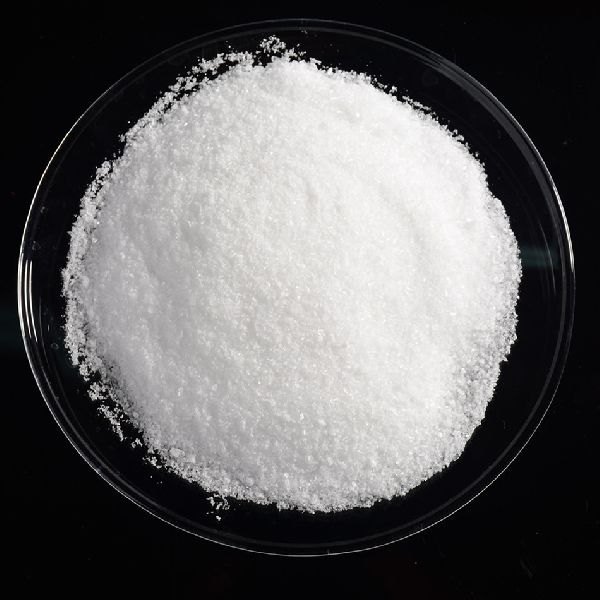
Ammonium bicarbonate (Food Grade)
Ammonium bicarbonate (NH₄HCO₃) is a white, crystalline inorganic compound commonly used as a leavening agent in baking and as a nitrogen fertilizer. It is also known by alternative names such as bicarbonate of ammonia, and baker's ammonia.
Key Properties
Appearance and Odor: A white or colorless crystalline solid with a characteristic ammonia-like odor.
Chemical Formula: NH₄HCO₃.
Solubility: Highly soluble in water, forming a mildly alkaline solution, but insoluble in most organic solvents like alcohol and acetone.
Thermal Instability: It is thermally unstable and begins to decompose at temperatures above 36 °C (97°F) into ammonia (NH₃), carbon dioxide (CO₂), and water (H₂O):
No Residue: When used as a leavening agent, it completely decomposes into gaseous products that evaporate during baking, leaving no salty or soapy residue, unlike baking soda (sodium bicarbonate)
Common Uses
Baking: Its primary use is as a leavening agent, particularly for thin, dry baked goods like crackers, cookies, and some types of biscuits. The rapid release of gas provides a light, airy, and crisp texture. It is not suitable for moist, bulky items like cakes or muffins because the ammonia gas can get trapped, imparting an unpleasant taste.
Agriculture: It is used as an inexpensive nitrogen fertilizer to boost plant growth.
Industrial Applications: It is used in the production of dyes, pigments, paints, and fire-extinguishing compounds. It also serves as a raw material for foamed plastics, in leather tanning, and for synthesizing catalysts.
Laboratory and Medical: In laboratories, it is used as a buffering agent in processes like liquid chromatography and protein analysis. It is an ingredient in some cough syrups.